The Token Economics of Local AI
TL;DR
This is the article every major cloud provider would prefer I didn’t write. The math isn’t hidden - it’s published in plain language on their own pricing pages, in their own documentation, in industry studies anyone can pull. They’d just prefer it stayed unread, because every company that runs the numbers and stands up its own inference layer is a company spending less on API rent. The answer at every scale - five-person startup, fifty-thousand-user enterprise, anywhere on the curve in between - is the same: the team that owns its inference layer pays itself back several times over the team that rents.
The Architecture
The per-million-tokens rate looks flat. It isn’t. Output is three to ten times input. Reasoning models bury chain-of-thought tokens inside that output bill. Every request re-pays the cost of the system prompt and any RAG context attached to it. None of that is broken out on the pricing page. All of it lands on the invoice.
The Enterprise Strategy Group ran the comparison in 2025 with Dell Technologies, modeling a 70B-parameter Llama 3 deployment with RAG over a four-year window across three architectures: on-premises Dell AI Factory, cloud IaaS, and pure API consumption. Here’s what the math looks like at the high-utilization end of the curve:
| Architecture | Cost per user, per month | Scaling shape |
|---|---|---|
| API service (GPT-4o-class) | $12.19 | Linear with traffic; never plateaus |
| On-prem 70B with RAG | $3.00 – $4.28 | Plateaus once hardware is racked |
At 10,000 users, on-prem comes in 52% cheaper across the four-year window. At 50,000 users, 62% cheaper. The gap widens with adoption - which is exactly the opposite of what most procurement assumptions are built on. If you want to run the same math against your own workload, two companion tools live on this site: the LLM Cost Calculator computes the break-even month between any cloud model and any local hardware option for your specific token volumes, and the Hyperscaler Pricing comparison tracks Bedrock, Azure Foundry, and Vertex on the same model with weekly-verified pricing.
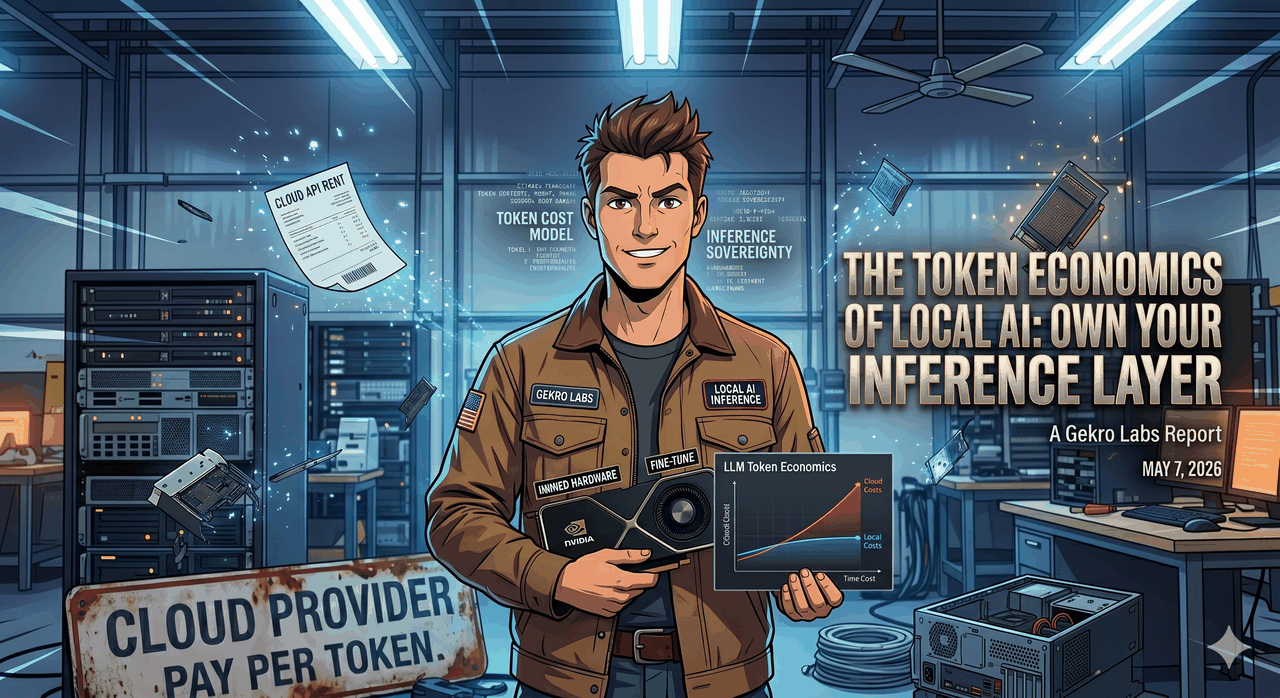
Forget the absolute numbers for a second. Look at the curves. API spend grows linearly with traffic and never plateaus. Owned-hardware spend caps at the hardware lifecycle. Adoption is the variable that decides whether you’ve built a moat or signed up for a tax. The Dell numbers are at enterprise scale, but the curve is fractal - a five-person startup watching its monthly Anthropic or OpenAI bill creep upward as it moves from prototype to production is on this same line, just at a smaller multiplier. The math doesn’t care about your headcount; it cares about whether your sustained token volume keeps owned hardware busy enough to amortize.
There’s a second axis that doesn’t show up in the dollar comparison at all. Cloud inference moves every prompt - system context, retrieved documents, intermediate agent state - across a network boundary to a third party. That triggers compliance scope, IP-leakage exposure, vendor lock-in around context-window roadmaps and rate limits, concentration risk if the provider has a regional outage at 3 AM, and pricing variance even between hyperscalers offering the same model. I call it inference sovereignty. Same conversation tech leadership had about data sovereignty five years ago, one stack down.
The objection I get from CTOs at this point is fair: “But Bedrock and Vertex and OpenAI all offer fine-tuning. Why do I need my own GPU?” Because cloud-managed fine-tuning is rent with extra steps. The training data still leaves your boundary. The adapter weights live on someone else’s infrastructure. Inference still runs at someone else’s per-request rate against someone else’s roadmap. You’ve added customization to the dependency, not removed the dependency. The local lab is the only architecture where your model, your data, and your inference loop are simultaneously yours.
The Build
The reason most teams never make this move is they confuse owning your model with training your model from scratch. Those are two completely different problems separated by four to six orders of magnitude in cost.
Don’t pre-train it
Stanford’s 2025 AI Index priced the training compute behind the frontier: GPT-4 at roughly $78 million, Llama 3.1 405B at $170 million, Gemini Ultra at $191 million. Those are amortized cloud-rental dollars, raw compute only - no data engineering, no MLOps, no salaries for the people who can actually run a multi-thousand-GPU cluster without bricking it. Even at the small end of the curve a 7B model from scratch is $50K–$500K and tens of thousands of GPU-hours. A 70B is $1.2M–$6M and a dedicated 256-GPU H200 cluster running for weeks.
Don’t do it. Nobody outside of frontier-lab budgets needs to.
Do PEFT it
The actual play is Parameter-Efficient Fine-Tuning on top of an existing open-weight base. Llama 3, Mistral, Qwen, Phi - already English-fluent, syntax-correct, world-aware. What you bolt on top is your domain: your taxonomy, your formatting, your decision logic, your tone. That’s a tiny adjustment in the parameter space, and modern techniques exploit it directly.
| Approach | Parameters updated | VRAM (7B base) | Compute cost |
|---|---|---|---|
| Full fine-tune | 100% (~7B) | 80GB+ multi-GPU | $10K – $35K |
| LoRA | 1 – 10% | 16 – 40GB | $500 – $3,000 |
| QLoRA (4-bit) | < 1% | 8 – 10GB | $50 – $500 |
The numbers in that VRAM column are baselines for a 7B model. To work out whether a specific model at a specific quantization actually fits a specific GPU, the GPU VRAM Calculator breaks it down - model weights plus KV cache plus activations against a curated table of consumer GPUs, datacenter cards, Apple Silicon, and Pi accelerators. Worth running before any hardware decision.
LoRA freezes the base weights entirely and injects small trainable rank-decomposition matrices into specific attention layers - you’re updating something on the order of 1% of the parameter count. QLoRA goes further by quantizing the frozen base to 4-bit, which collapses the memory footprint enough that a 7B fine-tune fits on a single consumer GPU. A serious adaptation run on QLoRA lands in the low hundreds of dollars and finishes overnight. The shape of the script - what’s planned for the next quarter of Gekro lab work against a curated dataset - looks roughly like this:
# gekro_qlora_train.py - Llama 3 8B + QLoRA via Unsloth + TRL
# Target: single consumer GPU (Mac Mini Metal or RTX 4090 class)
from unsloth import FastLanguageModel
from trl import SFTTrainer
from transformers import TrainingArguments

model, tokenizer = FastLanguageModel.from_pretrained(
    model_name="unsloth/llama-3-8b-bnb-4bit",
    max_seq_length=4096,
    load_in_4bit=True,
)

model = FastLanguageModel.get_peft_model(
    model,
    r=16,                                # LoRA rank
    target_modules=["q_proj", "k_proj", "v_proj", "o_proj"],
    lora_alpha=16,
    lora_dropout=0.0,
    use_gradient_checkpointing="unsloth",
)

trainer = SFTTrainer(
    model=model,
    tokenizer=tokenizer,
    # Expected JSONL shape per record:
    # {"messages": [{"role": "user", "content": "..."},
    #               {"role": "assistant", "content": "..."}]}
    train_dataset=load_curated_dataset(),    # your domain corpus
    args=TrainingArguments(
        per_device_train_batch_size=2,
        gradient_accumulation_steps=4,
        num_train_epochs=3,
        learning_rate=2e-4,
        optim="adamw_8bit",
        output_dir="./checkpoints",
    ),
)
trainer.train()
One file. One GPU. One overnight run. The output is a small adapter weight file you load on top of the frozen base at inference time, served by Ollama or vLLM the same way you’d serve the base model.
The hardware tiers - labs scale with team size, not corporate revenue
| Tier | Budget | Hardware | What it runs |
|---|---|---|---|
| Prototyping | $899 – $3,500 | Single consumer GPU (RTX 4070 / 4090) | Quantized 7B–8B at 40+ tok/s for one engineer |
| Fine-tuning | $7,500 – $14,000 | Dual / quad RTX 5090 or RTX 6000 Ada, Threadripper, 128–256GB RAM | LoRA / QLoRA jobs against 7B–13B bases, hours per run |
| Production-mirror | $75,000 – $250,000+ | NVIDIA L40S / H100 / H200, NVLink, 100GbE | Continuous batching, multi-tenant serving, MLOps validation |
A solo engineer running heavy AI workflows belongs at Tier 1. A team running sustained agentic workloads belongs at Tier 2. An organization serving thousands of users belongs at Tier 3. Same architecture, three multipliers. At every tier the payback math is faster than the procurement cycle that approved it - months at Tier 1, weeks at Tier 2 once fine-tuned adapters start serving real traffic, many times over at Tier 3 against equivalent API spend at sustained scale.
The serving stack has converged in 2026, and that’s the under-reported piece of the story. vLLM has won on throughput - its PagedAttention algorithm partitions the KV cache the way operating systems page virtual memory, and the gap between vLLM-served and naively-served on the same hardware is the difference between an idle GPU and a saturated one. Ollama has won on developer ergonomics for desktop and edge. TensorRT-LLM lives where you’ve committed to NVIDIA and want every last cycle. MLflow or Weights & Biases handle experiment tracking, because LLM fine-tuning is non-deterministic and reproducibility is the difference between a research demo and a production system.
You no longer need Anthropic’s or OpenAI’s infrastructure team to run production inference at scale. The stack that took those companies years to build is now a pip install and a config file. That’s new in 2026, and it’s the whole reason the math in this post works at every tier. I’ve already documented the Ollama-on-Pi pattern as architectural insurance and the GekroLLMClient that abstracts cloud and local providers behind one interface - both scale directly from a home lab into the enterprise tier.
The Tradeoffs
Owning the inference layer isn’t free, and pretending otherwise is how labs end up as paperweights. Four failure modes are worth naming.
Under-utilization kills the curve. The breakeven argument depends on sustained throughput. Stand up a Tier-3 server and run it at 8% utilization and you’ve built a very expensive paperweight. Cloud APIs are genuinely cheaper for spiky, low-volume work - that’s their best-fit shape, and you should keep using them for it. Before any hardware decision, ask: what’s the steady-state daily token volume of the workloads I’m internalizing, and is it large enough to keep the hardware busy? If the honest answer is no, stay on the API for that workload. Local hardware earns its keep by being saturated.
The Quality Cliff is real. A fine-tuned 8B against a narrow, well-defined task can match or beat a frontier API on that task - that’s the entire point of fine-tuning. But the moment the workload drifts into open-ended reasoning or multi-domain knowledge, the small model falls off a cliff. I’ve felt this directly. My Mac Mini happily runs a quantized 70B and the responses are perfectly usable for summarization, classification, and code review. They are also visibly less nuanced than what Claude or Gemini Pro return on the same prompt - shorter, more literal, more prone to missing the second-order implication of a question. The routing decision is the architecture, and it lives in the client wrapper:
# Hybrid routing - local for narrow tasks, cloud for long-tail reasoning
NARROW = {"classify", "extract", "summarize", "format", "tag"}
REASONING = {"design", "plan", "synthesize", "debug-novel"}

def route(task_class: str, prompt: str) -> str:
    if task_class in NARROW:
        return local_finetuned_8b.run(prompt)
    if task_class in REASONING:
        return cloud_frontier.run(prompt)
    return cloud_frontier.run(prompt)        # default: don't guess
Local for narrow, high-volume, latency-sensitive work. Cloud frontier for the long-tail reasoning the local model can’t handle. This is the heart of the API Sovereignty pattern - the lab doesn’t replace cloud, it eats the predictable workloads first. Every token the local tier handles is a token the cloud invoice doesn’t bill you for. Every token you keep on the cloud is a token you’re effectively paying to subsidize the provider’s next round of training compute.
The dataset is the moat, not the GPU. Compute is cheap. The QLoRA run that costs $300 in GPU time can sit on top of an annotation effort that cost the team $60,000 in expert hours, and on a serious DPO or RLHF run the human-labeling-to-compute ratio routinely runs twenty-to-thirty times in favor of the humans. That isn’t an argument against fine-tuning. It’s an argument that if your organization can’t articulate its taxonomy in writing, can’t agree on what a correct output looks like for your domain, can’t dedicate domain experts to annotation review - you don’t have a fine-tuning problem yet, you have a knowledge-management problem. Solve that first. The compute is the easy half. When you do start formatting training examples, expect format friction across frameworks - OpenAI’s chat schema, Alpaca, ShareGPT, and Unsloth/Llama all want the same data shaped slightly differently. I built the Fine-tuning Dataset Formatter to handle the conversion and flag the missing-turn errors that cause silent training failures.
Hardware refresh is brutal. That’s the feature, not the bug. Accounting depreciates servers over five or six years. AI silicon doesn’t cooperate. New GPU generations land roughly annually with substantial efficiency gains, which means an H100 procured in early 2024 is two architectural generations behind by late 2026. Plan for a 24–36 month refresh on the most demanding tier and a value-cascade pattern that moves older silicon down to lighter workloads - frontier training in years 1–2, real-time inference in years 3–4, batch analytics after that. The flexibility to refresh aggressively is itself a strategic asset. The cloud’s three-year reserved-instance commitment doesn’t give you that, and neither does the long-term API contract your finance team is about to sign.
Where This Goes
This post is partly synthesis and partly my own roadmap. I run local inference today on a Mac Mini and a Pi cluster, with the GekroLLMClient routing between cloud and local based on workload class. What I haven’t done yet - and what the next quarter of lab work is built around - is running an end-to-end QLoRA against a curated dataset on my own hardware, with the eval loop and MLOps discipline that turn a one-off fine-tune into a reproducible pipeline. There’s a second optimization surface specific to where I live, too: the Texas grid has its own opinions about when training jobs should run, and that one only opens up once you own the hardware in the first place.
None of this is hidden. The cloud providers writing your monthly invoice already know it. They’re betting your engineering team is too busy shipping features to run the math. Run it anyway.
Continue Reading
Related from the lab
AI Codes Like a Genius. Architects Like a Goldfish.
Why zero-shot AI POCs fall apart at scale, and how constrained architectural templates are the only thing standing between a clean codebase and a production time bomb.
500 Days and 30,000 Miles
Five hundred days ago I pointed a Raspberry Pi at my car and started keeping every mile it drove. It has captured 10.4 million data points without missing a beat I did not cause, and somewhere along the way it stopped being a logger and became something I can ask questions of.
The AI Watermarking Arms Race
Anthropic has started watermarking Claude's text output. How generative text watermarking actually works, why no third party can verify it yet, why detection power drops to the square root of the machine-written fraction once a document has two authors, and why I shipped a tool that says 'not checkable' instead of inventing a score.
Introducing Gekro News: An AI Briefing That Curates Itself Around Me
A public daily AI briefing that reads a profile of my interests distilled from my own knowledge base, picks the day's real signal, cites its sources, and publishes itself every morning.
Financially Air-Gapping A Raspberry Pi AI Swarm
How I turned a Pi 5 into a localized orchestrator using an MCP router and isolated OpenClaw worker networks to slash API costs.

Written by
Rohit BuraniAI engineer building local-first systems, self-hosted infrastructure, and autonomous tools from the lab.
The Lab Newsletter
Get notified when I build
something worth sharing.
No filler. No frequency commitment. Just the experiments, tools, and breakdowns I'd want to read myself.
Discussion
Comments
Powered by GitHub Discussions - requires a GitHub account.